 |
| HOME | CINEMA | GREEK CINEMA | FILMS - MOVIES | DIRECTORS | ACTORS | NEWS |
|
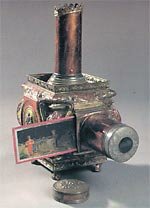
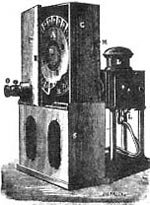
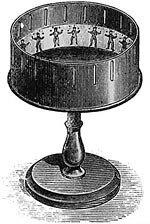
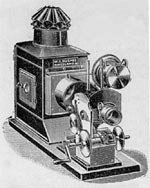
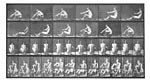
The origins of cinema The invention of cinema is a result of various ingenious invetions in numerous scientific fields. The ancient aspiration of representing reality was met by photography in 1839. You can read more on the inventions and breakthroughs that followed in the field of photography, in THE ORIGINS OF PHOTOGRAPHY. The need for the representation and recording of movement as well as that for the narration of mesmerising stories reached their complete expression through photography. Plato’s “Cave” (gr. “Spilia”) can be traced back to the roots of photography; its magical walls host the most extraordinary sights. There, we meet with the ancient greek writer Loukianos, who in one of his fiction stories about a trip to the moon, refers to a mirror placed at the opening of a well, within which one can see images and hear talks from the life of humans on the planet Earth. Ptolemeos is the one who first constructed a device of optical tricks (Ptolemeo’s Disc) which was effectively based on the movement of the disc, parts of which where painted with different colours. Just a little bit earlier, Heron, the big inventor of ancient times, devised a system with mirrors, which, when playing with the elements of shadow and light resulted in leaving the viewers absolutely dazzled. However, all of those activities came to an end, due to their understanding as idolatrous and devil’s workings by the Christians in the Middle Ages, which stopped their further development. We have optical experiments reappearing after the Rennaisance period. The most important invention of that time was that of the “Magical Light”. Its fathership is claimed by many; Christian Huygens, Rasmussen Walgenstein, Reeves, Dechales. The first to describe it is the hisouiths Athanasius Kircher in his work ‘Ars Magna Lucis et Umbrae’ (‘The big Art of Light and Shadow’). The ‘Magical Light’ was the precedent of the transparency projectors and with its many varieties and developments it was still used and was quite popular until the 19th Century (lanterna magica). In 1816, the later inventor of stereoscopical photography Sir David Brewster constructed the first kaleidoscope. In the decade of 1920-1930, the Belgian physician Joseph Antoine Ferdinand Plateau constructed the Anorthoscope and soon after that the Phenakistiscope, which was also known in the market as Phantasmascope or Fantoscope. In 1825, Paris constructed the Thaumatrope, which, was seemingly an idea of Sir John Herschel. In 1834, William George Horner made a system which he called Daedalum and was forgotten for over 30 years, until it came back by William F. Lincoln and M. Bradley, with the name Zoetrope. With its quick movement and drawn images, it resembled a cartoon. The person who came close to the cinema like no one else, was the French Emile Reynaud, in 1878. If, instead of his drawn paper tapes he had thought of actually showing film with his Praxinoscope, today we would have been refering to him as the inventor of cinema. However, we can definitely consider him to be the father of cartoons. An argument on the galloping of horses and a bet of 25,000 dollars of the governor of California was the reason for Muybridge to be placed under the spotlight. Eadweard Muybridge was known for his photographic studies of movement and governor Stadford asked for his input in order to prove his beliefs. Muybridge constructed a structure constisting of 30 cameras, whose shutter would open up by a thread split by the horse as it passed right in front of them. This series of photographs made Muybridge famous and gave birth to the idea of cinematic cameras. Up until this point, human knowledge had given everything it needed to. It was then time for Thomas Edison and Louis and Auguste Lumières to invent cinema. THE ORIGINS OF CINEMA |
|
Welcome to www.cinemainfo.gr a website dedicated to the art of cinema. Everything about cinema. A creation of www.internetinfo.gr
INTERNETINFO © ΚΙΝΗΜΑΤΟΓΡΑΦΟΣ INFO.GR