
|
| HOME | CINEMA | GREEK CINEMA | FILMS - MOVIES | DIRECTORS | ACTORS | NEWS |
|
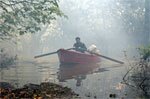
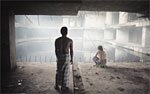
47th THESSALONICA FILM FESTIVAL Written by Giannis Frangoulis Translated by Konstantinos Vassilaros BEYOND THE DREAM On the fifth day of the Festival, some films gave us hope that something actually changed in the Greek cinema. Two films were screened; one of them was reminiscent of the good days of qualitative cinema. If in fact the film avoided certain pitfalls, then we would be dealing with an actual great film. Let us take things one at a time. The Greek Films Two Greek films were shown today. The first one, is a Greek/Cypriot co-production, called “Milk with honey”, directed by Marinos Kartikkis, and deals with the relationship after the coincidental meeting of two women. Ellen and Rea, both live in neighboring houses, but never had the chance to meet, up until Rea knocked on Ellen’s door in order to call a locksmith. A relationship will flourish but will take a different path when Ellen witnesses a clash between Rea and her boyfriend. The memories, the present and the past, intermix in order to create a new world. However, the director and scriptwriter do not manage to uncover certain elements, forbidding the story from obtaining a cohesive narrative while the film fails to answer many questions and leaves the characters in an uncertainty. The weak editing is incapable to articulate the narrative, and the film is left out in the open. The latest film by Stratos Stasinos, “Beyond the lake” offers us an opportunity to take a look at his previous work. His previous film, made eight years ago, was “Ipiros”. This film also deals with the region of Ipiros, but somehow in a different way, using poetry in order to best express reality. A young man that lives in a village catches a glimpse of a woman who appears to him as a fairy. He will immediately fall in love, and will immediately start looking for her. The search will lead him to places beyond the lake, at an abandoned village, where some terrible things took place between a witch and a family. A woman he meets there will cast a spell on him, and make him fall in love. The lust for this woman will act positively for his other love towards the unknown woman. Stasinos, with the help of his cinematographer, has managed to create a dream-like atmosphere, with beautiful shots, and remarkable use of light, inserting elements of a harsh reality that break the dream-like atmosphere, and in consequence, create problems in the structure of the dreamy world the director wants to sustain. In all, his effort is noteworthy and interesting. The foreign films As part of the International In-Competition department, the Canadian film by Joshua Dorsey, “The point” is screened, as a comment to the modern American society. It captures the urban landscape of the country with a modern approach and unites its narrative elements with fast editing, thus creating a modern film about a current problem. The violence lurks, and to a large extent remains as the main characteristic of the characters. This is a realistic film, with strokes of poetry, without being labeled as a poetically realist film. However, the film does not manage to make a conclusion, leaving it somewhat incomplete. At some point in the tribute to the Chinese Cinema, we saw the film “Waiting alone”, directed by Dayyan Eng. It’s a film about people, with a very simple script and linear editing. The narrative does not appear to be extremely gripping, but the film simply fulfils its story, an erotic relation between a man and a woman that finally reaches a climax. At the “New American” screenings, we saw the film by Kelly Reichardt, “Old joy”, a clearly typical American film. Classic narrative, delivered in the naturalistic way of the American society and nature, telling the story of a voyage of two old friends, dealing with their problems, until in the end the solutions to their troubles reveal themselves. This overused script format will once again leave us with nothing to remember. Other films The film that surprised us with its gripping intensity is a Taiwanese/French/Austrian co-production, titled “Don’t want to sleep alone”, directed by Tsai Ming - Liang. It tells the story of a homeless Chinese man, who gets attacked and is taken care of by some immigrants until he succumbs his wounds. Following this event, a love affair will develop between a waitress and the shop owner the waitress works in. In a very subtle style the director manages to build complete characters, and by testing them with the predicaments of life, he allows the meaning of the film to emerge, a meaning so universal that acquires a humanitarian value. The editing style is slow-paced when the development of characters takes place, and fast-paced when there is action, hence the narrative elements are easily comprehended. The absolute realism of the film hides a poetic lyricism behind it, which makes the film part of a poetic filmmaking style with a liberated attribution to reality. This film can be added to the list of the modern ground-breaking Taiwanese cinema, and the works of Hou Hsiao-Hsien. From Malaysia comes the film by Ho Yuhang, “Rain dogs”. This is a typical Eastern film, with a modern narrative. Slow rhythm, stylized shots, long silences and attention to the landscapes. The director focuses on the conflict, between the innocence of small urban towns and the alienation of the metropolis, making a beautiful social comment. We will continue reporting, and we will watch as many films as possible and comment on them, for you. We are trying to transport our readers into the climate of the Festival, a climate that has affected the whole city and mainly its harbor and its biggest square. Tuesday 21st November 2006, Giannis Frangoulis 47th THESSALONICA FILM FESTIVAL - BEYOND THE DREAM |
|

Welcome to www.cinemainfo.gr a website dedicated to the art of cinema. Everything about cinema. A creation of www.internetinfo.gr
INTERNETINFO © ΚΙΝΗΜΑΤΟΓΡΑΦΟΣ INFO.GR