
|
| HOME | CINEMA | GREEK CINEMA | FILMS - MOVIES | DIRECTORS | ACTORS | NEWS |
|
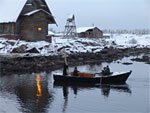
47th THESSALONICA FILM FESTIVAL Written by Giannis Frangoulis Translated by Konstantinos Vassilaros A SURPRISE FROM VOULGARIS Carrying the heavy load from the sudden news of Altman’s death, the festival continued its events ad screenings as planned. We got to watch films, Greek and foreign, and travel in distant places and discover new people from the world. Three Greek films were screened today and fortunately we have a lot of positive things to talk about. The Greek Films We begin today’s reporting with Antonis Mposkoitis’ film, “Alive in the Cell”. A film that take us 40 years back, a time during which legendary club “Cell”, on Ipirou and Acharnon street, housed a lot of up and coming rock groups, that would soon become part of the Greek Rock Music scene. There the first appearances of the relatively unknown today rock groups of Poulikakos, Sidiropoulos, Agapanthons and many more took place. Mpoiskotis, with an excellent knowledge of the musical scene, being a journalist himself for a music magazine, had no problems making his research. Subsequent to the research however, the problem begins. Accomplishing the transformation of factual events into a narrative is a very difficult subject to analyze, and this is what a lot of Greek documentaries fail to achieve. When this transformation fails, we are dealing with a product made for television. This film begins with a poem recitation, and places us in a fictional story, obtaining a troubled narrative flow which will be interrupted by Mposkoitis’ characteristic hand gesture ordering “Cut!”, and the end of the film. The second film screened was “The Son of the Guard”, by Dimitri Koutsiampasakos. It’s his first feature film, and is accompanied by three absolutely successful short films amongst them an exceptional documentary on Acheloos River. The film is an adventure set in the Greek mountains, near the area of Ipiros, the second film this year dealing with that area of Greece. A journalist will try and play a joke, but someone will steal a pistol that he has hidden. Bad luck for him, because the weapon belonged to his father, and it ends up in the hands of the Police and he is in real trouble. He finds the thief, but he will have to travel to the village of his mother in order to get a hold of him. There he will be faced with numerous problems, all focused towards the son of the village’s guard. An adversity will begin between the two young men that will end tragically. Unfortunately the script is not coherent enough and nothing is there to keep us interested. The effective and high-quality editing and the excellent photography will finally save the film. The film “Pink”, by Alexandros Voulgaris, surprises us. The truth is we went to see the film with a negative predisposition, because his previous short film, “The Right Moves”, and his first feature film, “Crying», were not good. We detected some disposition of experimentation but it did not lead anywhere. In his new film though, Voulgaris follows a completely different path from his father, Pantelis Voulgaris, and created an almost unwavering narrative, without any surprises or alternations. It managed to keep the spectator interested, by hiding behind the narrative, important issues concerning both Greek and Foreign people. A love relationship between a teenage woman and the protagonist, which remains in a platonic level, and the alienation of the protagonist, creates a mood of a city that “swallows” its own inhabitants. In the end of the film the solution and the purgation of the story takes place, but once again, in a very subtle way. This is a narrative style we rarely encounter in Greek films, but it looses its originality when taken outside its country’s borders. The foreign films Today’s screening of the foreign films, commenced with the film “Retrivial” by Polish director Slawomir Fabicki. We are dealing with a classical American style film that has little to add to the World Cinema legacy. The camera movements were very interesting, almost moving into a subjective form of shooting; the editing was relatively speedy, following the basic rules in order to adequately structure the characters. However the correct elements to create something interesting were absent. The script after the first ten minutes already expired, and we were left waiting for a clichéd ending, that by no means amazed us. From as far as Philippines came the film “Kubrador, The bet collector”, by Jeffrey Jeturian. A realistic narrative, resembling a lot to Italian neorealism, with a very appealing subject of the poverty in Philippines and the unconventional ways of making money, even followed by the Police. However, beyond the accusations made towards the government, we did not manage to find anything worth mentioning. In addition, the editing style did not help articulate the film’s motives. On the contrary, the film by Pavel Lounguine, “The Island”, was reminiscent to the Old Russian cinema. The story is about a strange person who is tormented by certain mistakes he made in the past. During World War II, under a lot of pressure, he kills the captain of the ship in which he served. Now he lives and serves in a monastery isolated from the world. He has the reputation of being an intellectual person, but he believes he is worth nothing. The film filled with spiritualism reveal us all the sides to the story. The very slow-paced editing describes and analyzes the social and psychological situations of the character, the shots continuously switching from close-ups to wide shots, and the endless tracking shots, take us to the very beautiful landscape of northern Russia. This is a very beautiful film firmly holding to its Russian filmmaking legacy, especially the ones of Andrei Tarkovski and Sergei Paradjanov. From France, Austria and Hungary comes the film “Taxidermia”, directed by Gyorgy Palfi, making a historical report about Hungary, using as a reference a grandfather, a father and his son. These three characters and their relationships which include many other different individuals, allow us to witness the history of Hungary, dating from 1940 up to today. In a very beautiful style, we travel from season to season, without interrupting the narrative, but with an escalating interchange of shots. At some points the film challenges us, reaching the point of being grotesque; nevertheless, this odd quality absolutely suits the style of the film, realistically portraying the absurdity of Hungary of the times. Four days remain for the Festival to draw to a close. We still have enough films to watch and write about. We still have a lot of Greek and Foreigners to watch. Wednesday 22 November 2006, Giannis Frangoulis 47th THESSALONICA FILM FESTIVAL - A SURPRISE FROM VOULGARIS |
|

Welcome to www.cinemainfo.gr a website dedicated to the art of cinema. Everything about cinema. A creation of www.internetinfo.gr
INTERNETINFO © ΚΙΝΗΜΑΤΟΓΡΑΦΟΣ INFO.GR