
|
| HOME | CINEMA | GREEK CINEMA | FILMS - MOVIES | DIRECTORS | ACTORS | NEWS |
|
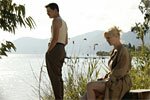
47th THESSALONICA FILM FESTIVAL Written by Giannis Frangoulis Translated by Konstantinos Vassilaros “PANDORA” OF GREEK CINEMA The festival is slowly getting closer to its end but the crowds in Thessalonica insist on queuing up to watch films, Greek or foreigner. After all these years of the Festival an audience has been formed fertilizing the filmmaking world for new, groundbreaking cinema, new types of films and new filmmakers, filling the cinemas to watch all films, from Mongolia to Mozambique, and even Tajikistan!! The question however remains: What will happen to this unique audience after the Festival? Why don’t they keep on going to the movies during the rest of the year? The focus of our final outcome will be to provide an adequate answer to this question. The Greek Films We will once again begin our report with Nikos Perakis’ latest film, “Loufa kai Parallagi: Sirens of the Aegean”, a film that has already been released, has made its money and completed its circle. We saw the film and we could not detect any resemblance to its prequel “Loufa kai Parallagi” (1984). Its unique humor, its understanding of the new situation of the Greek army and its consideration to the modern characteristics of our soldiers were all absent from the film. Nevertheless people laughed and it was quite amusing to watch. Stelios Charalampopoulos, with his documentary “I. Moralis”, brings us a film about Moralis, similar to his previous documentary on famous Greek poet, Seferis. Carrying on with the same sensitivity, respect and sincerity, he manages to fully capture the essence and the persona of the artist. Using Moralis as an excuse, he was able to comment, in an indirect way, on the generation of 1930’s, one of the most important generations for Greek artists. Panikos Chrysanthou will bring us the Cypriot film, “Akamas”, which already has been screened at the Berlin Film Festival. This political film raises the issue of the National Organisation of Cypriot Fighters, the unacceptable behavior of both Cypriot Turks and Cypriot Greeks and the oppression carried out by the British. All the issues raised in the film are accompanied by a love story between two adolescents. The narrative is unprocessed and realistic, avoiding any literary elements; the filmmaking style is similar to the one of old Greek cinema. This exposure of the event that took place in Cyprus disturbed many, forcing the producers to back down revealing the true, oppressive political forces of Cyprus. This is definitely an act of censorship, taking place in a country that wants to be considered as democratic. The last Greek film screened was the film “Pandora”, by Giorgos Stampoulopoulos. Finally Stampoulopoulos after 15 long years he brings us one of his films. The last film he made was called “Two suns in the sky”. His recent film, “Pandora”, explores a completely new subject. The film refers to the German Occupation, the Greek Civil War and the post-Civil War period. A family, the father, the son, his uncle and his father’s aunt will undergo an unforgettable adventure. A woman will enter their life and just like Pandora from the ancient Greek times, she will try and finally succeed to destroy anything she finds in her path. Theodora Tzimou once again plays the role of the little “whore”, provoking the characters with her erotic behavior and her beauty. She will manage to “steal” one of the brothers and then when she tries to do the same with the other brother, who just came out of prison, she will fall into her own trap revealing her own evil plans she was preparing along with some of her American friends serving at a nearby military base. We travel from the past to the present, via certain items and camera angles. Still, the cinema of Stampoulopoulos remains old fashioned, and fails to use a fast editing style best articulate his intentions, making the structure resemble with that of a decent movie made for television. The foreign films If we consider Stamatopoulos’ film as old fashioned wait till we see the Chinese film “Trouble makers”, by Cao Baoping, screened as part of the International Competition Program. The film can be classified as cinema from the 1940’s, cinema for the working class. Consider this remark as a condemnatory comment on the style and theme of the film. The story is about settling a feud between a village and the local mafia. In case the film reminded you of Kurosawa’s film work, be sure to remember that its aesthetics do not even closely resemble to it. Finally when the police intervenes then we are reassured that we are dealing with an absolutely “cult” film. Out of competition, the film “Kythera”, by Peter Meszaros based on Jean-Antoine Watteau’s painting, “L' embarquement pour Cythere”, tells a story of a couple living a totally conventional life. Their dream is to leave for vacation to Greece, specifically in Kythira. Instead, they will have a baby and its arrival will create mayhem to their marital life. The aesthetics and mood of the painting with certain static shots but also with the actors acting style can be detected, offering a romantic tone to our lives. This is a high-quality film, but someone must study the film closer to find the art references subtly made by the director. The director studied in Hungary and Georgia and received numerous awards from various Festivals. This film reminded us of the older Hungarian cinema, but with a completely new and modern take. The German film “Riding up front”, by Marcus Herling was also a first-rate piece of work. The film focuses on man; the director illustrates some examples of different people and criticizing them. It’s Christmas Eve in Berlin and there is a festive atmosphere, however some people cannot be part of it. Herling’s film follows the rules of humanist cinema and humanist theatre, resembling a lot to the style of Strindberg. The film peaks using basic moral principles as an indicator of man’s social fall. The other foreign films In addition to the previous films we will discuss three other foreign films. The Chinese production of Hou Yong, “Jasmine women”, completely disappointed us. Once again in an old fashioned style of filmmaking, almost as a caricature, with nothing special to offer. On the contrary, the film of Pablo Trapero, “Born and bred”, was an effective intense criticism of the modern Argentinean society. This Argentinean/Italian/British film spoke to us in a modern film language about the steaming subject that concerns almost everyone: Today’s structure of family today and the impact of the intense professional activity of both parents. Beautifully directed, explaining clearly the subject to the audience, entering the story right after the shock that stroke the protagonist, and by that challenging the main character as well as the resistance of our society. We will finish our reporting with the film “Gretchen”, by Steve Collins, an American production, dealing with a catatonic girl, which has perseverance with the “bad” boy of her school, with sex and erotic stroking. These passions will lead her to a psychiatric clinic, she will try to be cured, but soon after returning to the real world, she will critically injure her lover forcing her to return to the ward. There she will fall in love with another inmate thus acquiring a new life without perseverance. Delivered with in a beautiful manner by the director, who taking us close to the woman’s life and the stages she goes through, using montage as a tool. The first-rate editing helps structure believable characters and reach a calamity which will lead to the solution. We will continue reporting on the appreciable films of the festival, thus drawing our conclusion for the outcome of this Festival. Thursday 23nd November 2006, Giannis Frangoulis 47th THESSALONICA FILM FESTIVAL - “PANDORA” OF GREEK CINEMA |
|


Welcome to www.cinemainfo.gr a website dedicated to the art of cinema. Everything about cinema. A creation of www.internetinfo.gr
INTERNETINFO © ΚΙΝΗΜΑΤΟΓΡΑΦΟΣ INFO.GR