
|
| HOME | CINEMA | GREEK CINEMA | FILMS - MOVIES | DIRECTORS | ACTORS | NEWS |
|
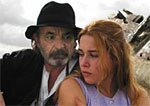
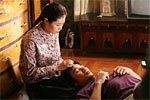
47th THESSALONICA FILM FESTIVAL Written by Giannis Frangoulis Translated by Konstantinos Vassilaros WITHIN THE LIMITS OF CINEMA Two days are left before the Festival comes to an end, and by now almost all Greek films have been presented. The festival’s agenda will continue its course until this coming Monday, followed by a re-screening of all Greek Films for those who did not have a chance to watch them during the past week. The foreign schedule continues its course with a lot of interesting new films. Taking into account that both the current and last year's international films were not great, we are not expecting to see anything mind-blowing during the last days at the Thessalonica Festival. We will have to satisfy our artistic appetite with mediocrities. The Greek films To begin with we will discuss the film “Dying in Athens”, by Nikos Panagiotopoulos, which was screened at a bizarrely early time. Panagiotopoulos began his career with his first film, “Colors of the Iris” (1974), followed by the legendary “The Lazy People from the Flourishing valley” (1978). Up until 1988 he continued making good films. Conversely the quality of his cinema went downhill after the film “Dreaming about my friends” (1993), and “The Bachelor” (1997), while in 1999 made a tough promise to make one film every year. He was unable to keep his promise, an impossible pledge to keep, especially in Greece, one of most difficult countries to make films. Despite the difficulties he managed to release a new film approximately every two years. Filmmaking however is a matter of inspiration and not keeping promises. His last film was a musical, a rare kind of musical with a depressing theme. The film quickly became dull and his characters became silly caricatures. Subsequently to Panagiotopoulos’ film, we will comment on the documentary called “The Pleaders”, made by Stavros Ioannou, about a group of illegal immigrants found in Evoia living in an abandoned factory. The director makes a plain and simple recording of events. He does not attempt to go any deeper in order to articulate his statement or even recreate reality through his ideological point of view. The visual and original materials are limited and poor, enough to simply depict the arrival of the immigrants. These weaknesses refrains us from considering this work as a film-documentary. The only film from his past we can confidently keep in our mind is “This was a tragedy” (1994). Sabbas Karidas makes his début with his first feature film, “Within limits”. He directs a road film focusing on the life of a taxi-driver. The taxi-driver is living a lie since he is only living through the stories of his customers. Throughout the film there are allusions that the character will manage to escape from his deceptive life. A woman that rides his taxi also becomes part of his fantasy while he strongly desires to live a different and unusual erotic experience. He finally decides to take his life in his own hands and make his own story. The film by Katerina Evaggelakou, “The hours of public silence” is a bad sample of the likeable director’s career. Following her previous film, “You will regret it” (2002), Evaggelakou directs a film that endeavors to satirize the Modern Greek society. However she will not manage to form an effective satire, but wind up making grotesque film where the tragedy becomes the comedy and the comedy turns into a ridiculous show. I can picture that she was inspired by certain French or American films, but she failed to make her film resemble to those kinds of films. The movie does not convince us and can only be praised for its good intentions. The foreign films The Korean film by Kim Tae-Yong, “Family Ties” left a very good impression. The director and co-writer did not only tell the story of the protagonists, he also successfully portrayed the relationships between those individuals. Consequently we are presented with difficultly recognizable characters creating and unknown and fresh feel, while the script does not allow us to make any discrimination about the fully shaped characters. We are exposed to a universal image of society, and not a simple one-sided representation of people. Excellent direction with a clear and articulate editing style allowing the story to develop with a firm and complete content. I strongly believe that it was the best film from the international program. On the contrary, the Iranian film “On a Friday afternoon” directed by Mona Zandi Xaghighi is not as strong and it could be easily labeled as a typical Iranian film. Slow paced, with unconditional realism and a superficial lyricism. This is film is not even close to the level of the works of Makhmalbaf or Kiarostami. We will draw to a close with the film of Kojtim Cashku, “Magic eye”, an Albanian/German co-production. This film finds Albanian cinema at its best. We’ve seen at the same Festival “Tirana year Zero” that won the Golden Alexander award couple of years ago, but now we have a film from Albania describing an underlying disappointment for the country. The film is set during the year with the pyramids and the fall of Berisha’s regime, a year that deeply marked the conscience and historical memory of Albanians. How could it not affect the people so strongly, when the Pan-Albanian revolution dangerously reached the limits of becoming a civil war killing unjustly a lot of innocent people? In this film cinema spirals back into its own cinema when some amateur filmmaker shows his friends the artistic silent films he directed. He will accidentally film a staged murder of an old man by a television reporter. They both will find themselves traveling together, being threatened by each other. A very prominent satire about the mass media and how they can create commotion out of nothing. We will continue our correspondences from Thessalonica for the remaining two days, all the way up to the Award and Closing ceremony. After the end of the festival we will focus on the tributes, homages and events that took place during the festival. Friday 24th November 2006, Giannis Frangoulis 47th THESSALONICA FILM FESTIVAL - WITHIN THE LIMITS OF CINEMA |
|
Welcome to www.cinemainfo.gr a website dedicated to the art of cinema. Everything about cinema. A creation of www.internetinfo.gr
INTERNETINFO © ΚΙΝΗΜΑΤΟΓΡΑΦΟΣ INFO.GR