 |
| HOME | CINEMA | GREEK CINEMA | FILMS - MOVIES | DIRECTORS | ACTORS | NEWS |
|
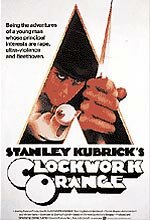
A clockwork orange Clockwork, Orange. ‘Orang’ in the Malayan dialect of Thailand and Singapore means ‘person’. Result - a clockwork person; a being with no personal will who operates only for other people in a certain way. Alex and his gang are sitting on the big couch of Korova Milk Bar while drinking their favourite refreshment, Milk Plus. Soon enough they get up and enter the extravagant and gloomy futuristic world of England. With them, Stanley Kubrick takes us into one of the most perfect examples of brilliant cinema. Sex, drugs and rock n' roll? Not precisely… we would rather describe it as rape, drugs and Beethoven. In 1962 Anthony Burgess releases his book about the adventures of young Alex, inspired by a personal dreary event: the rape of his wife by 4 American army deserters during World War II. The book immediately stood out with its violent thematic content and its shocking colloquial language and phrases used by the members of the gang (a mix of Russian and English with a Shakespearean form, where the words are repeated to create small poems and rhymes between their phrases). Set in future England, sunk into the darkness where teenagers vandalize, rape, and take drugs with their afternoon tea, and with a government that removes freedom and initiative from its people by using misleading stratagems. It is a unique film with a theme and style that suits Kubrick like a glove; his directorial signature is evident throughout the course of the film. From the first shot of the “Kubrick stare” (close-up shot on the central character Alex with his head slightly tilted with a penetrating look aimed straight towards the camera and the audience; a shot that is repeated in many other of Kubrick’s films: Dr. Strangelove (1964), 2001:A Space Odyssey (1968), Barry Lyndon (1975), The Shining (1980), Full Metal Jacket (1987) and Eyes Wide Shut (1999). Always with the typical obsessively perfect balanced shots (concerning its geometry, lighting and colours). Of course we should mention another more essential aspect of the film’s style: its dialogue always has a concrete appropriateness, the characters’ actions always add something to its surrounding, and with a study of the psycho being of the main characters that even Freud and Pavlov’s dogs would envy. The themes and problems brought up by the book and the film are not few and create a lot of provocative questions and symbolisms. How one can tare evil away from modern society? If the government is allowed to eliminate free will from its people making them “a clockwork orange” what does that imply about the nightmarish methods used to alter their behaviour in order to “fight” crime and evil? Do we lose our humanity and compassion if our free choice between good and evil is deprived from us? And with which criteria does society decide what is bad and what is good, and whose criteria are those? A lot can be said about this film and most of these issues raised were appreciated much later, because each era has its corresponding censorship, which finally directs the point it’s trying to censor to a completely new form. To begin with, the film was censored due to its violent and sexual content. Subsequent to that it was accused as the main reason for the acts of violence that took place in the present gloomy world of England. A 17 year old girl was rapped under the sound of “Singing in the rain” that was hummed by her rapists, just like Alex’s gang did in the film. In addition a 16 year old boy tortured a younger child wearing the facsimiled uniform of Alex. Both events proved that the film had a negative impact towards the society. Kubrick was forced to cut 30 seconds from his final cut in order to get the approval from the American Censorship Committee and to be able to screen it in the United States. The original final cut was released only after 2000 in British cinemas, after the death of the filmmaker. Just like Alex after his “transformation” into a person of good is immediately rejected by the society, Kubrick himself ironically puts himself into the position of denying his creation and withdrawing it from the cinemas in order to avoid further problems and misunderstandings. Kubrick later on took back the charges against himself. Unfortunately all these issues covered up other smaller aspects of the film that were absolutely pioneering for the time. Its music, the groundbreaking sounds of electronic music by Wendy Carlos, and its original costumes referencing to Dionysian orgies and military fascist uniforms. Things that today are duly appreciated by the pop and rock artists that portray themselves in their music videos as Alex’s gang all the way to the “remake” of the film as a hardcore porno with the title “Clockwork Orgy” (truthful however towards the dialogue, costumes and the plot). From various remakes and clever remixes of the main theme up to merchandises (posters, budges, T-shirts and tattoos). The best phrase suitable towards the chaos the film created is: '' as queer as a clockwork orange '', meaning that something is internally strange and alienated, even if it does not appear as such from the outside. A CLOCKWORK ORANGE |
|
Welcome to www.cinemainfo.gr a website dedicated to the art of cinema. Everything about cinema. A creation of www.internetinfo.gr
INTERNETINFO © ΚΙΝΗΜΑΤΟΓΡΑΦΟΣ INFO.GR