 |
| HOME | CINEMA | GREEK CINEMA | FILMS - MOVIES | DIRECTORS | ACTORS | NEWS |
|
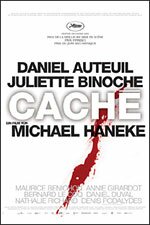
“Hidden/Cache” by Michael Haneke Michael Haneke's Cache is a carefully structured cinematic dialogue with the audience. This is a film about privacy and invasion, family and guilty history, and the fact that soon enough after escaping from our actions and our mistakes we will face the consequences. In the case of our character, Georges Laurent, his reaction to his past mistakes is glacial and he is in denial. This theme brings us back to Haneke’s first Trilogy about violence in his country, Austria, also known as his Glacial Trilogy. Those films are: “The Seventh Continent”, “Benny’s Video” and “71 Fragments of a Chronology of Chance”. Complete absence of music, zoom, forced editing, informative montages, and camera manipulation and with a complete sense of realism. However one can argue that the events taking place in this film are somewhat supernatural. Georges Laurent (Daniel Auteuil) is a Paris television personality who hosts talk shows discussing intellectual matters of literature and other current affairs. Haneke’s characters tend to be bourgeois upper middle class people faced with extreme situations. His wife Anne (Juliette Binoche) is a publisher. Their 12-year-old son Pierrot (Lester Makedonsky) seems to be a troubled teenager. The film starts with a very long shot of a narrow Parisian street, with the camera looking towards the entrance to a stylish little home. Only when the image switches to fast-forward do the audience realizes that they are watching a videotape along with the residents of the house. The audience hears the conversation of the characters discussing and wondering on its origin and purpose. Haneke’s film reminds us a lot of Alfred Hitchcock's idea of film; the fact that watching films is a form of voyeurism. We as the spectator intrude into private lives of certain characters and that is what we enjoy most about watching films. In the film it is never revealed who actually records and sends those tapes to the family. In a way we the audience are as guilty as the person who terrifies the French family. Is this film more than just a comment on the history and the relationships of the French with the Algerians and Arabs? This film could be taken as a harsh commentary on our habits of watching films. We walk into a theatre we sit down and we live and see through the eyes of someone. We are thrilled and scared when we watch violence, but we are glad that we are not in that situation in reality. This sense reminds us a bit of the film “Being John Malkovich” by Spike Jonze, where the characters plunge into the mind of John Malkovich and watch his life through his eyes. The only difference is that the character played by John Cusack manages to take control of his mind and body due to his puppetering skills. The director, the audience and the person who records those tapes become the stalker. Throughout Haneke’s work there is a very distinctive style about his use of camera. His shots are still, long and fragmented. The camera does not have a mind of its own. It does not wonder off with impressive tracking shots of the surroundings, or crane shots starting from an object and panning to the character. Haneke’s camera strictly follows the character or the object he chooses. If the chosen character is not moving then the camera will not move as well. In many cases Haneke might choose an object for his shot that tells a story. The camera will remain on the object and the conversation of the characters will be heard off screen. His camera use reminds us of a CCTV security camera firmly fixed, cold and frigid. Although we soon realize that Georges does actually have a secret from his past who could actually been terrorizing him, it still remains unclear with the end of the film. In a way it is left to the audience, the stalkers, to decide if his actions were right or wrong, if the film was good or bad or if it is Georges fault or not. Georges’ reaction to his past and the events is to take some sleeping pills and sleep it off. However his dreams haunt him. There is the final scene were we the audience are presented with a very wide shot of what actually happened that day. It is not clear if we are watching through the point of view of Georges or if it is another of those tapings. This visual declaration of guilt might be a sign that Georges finally accepts responsibility for the tragedy that has provoked this strange conflict. Early in the story, Georges wonders how come he didn't see the stalker in the room, when he went to meet his possible stalker, Majid. In the end we realize that he himself is the stalker of his own conscience and he is the source of the evil. We all have done something wrong in our past. We all have had our conscience chase us and remind us of the past. It is up to us to re-watch those tapes of our memories and accept them. Those tapes could have been sent to Georges by Georges himself, or by us the audience who watch and judge. The audience is part of the film; we are the secret in the film. We are George’s conscience. The last shot of the film reassure us on the point of the film. A recording of a school’s entrance and maybe another VHS tape investigating another buried guilt. If someone watches closely one can see on the upper right hand corner Georges’ son, Pierrot talking with the son of Georges’ enemy, Majid. This further complicates the plot, but it also shows that Pierrot was friends with that family all along and he knew all those horrible events that took place. His son also acts as his conscience along with the audience. The shot also conveys another point the film is trying to make. In France's passionate intellectual liberalism the huge disadvantaged Arab underclass still exist and struggle to live their lives as free people in a so-called liberal country. The last shot foretell in a way the Muslim riots that began in Paris' suburbs and soon spread throughout France. This also comments on humanity’s assertion that everything will be solved when the next generation learns from political history. So far things show that people do nothing more that completely ignore the past and regularly repeat history’s mistakes on a larger scale every time. Konstantinos Vassilaros |
|

Welcome to www.cinemainfo.gr a website dedicated to the art of cinema. Everything about cinema. A creation of www.internetinfo.gr
INTERNETINFO © ΚΙΝΗΜΑΤΟΓΡΑΦΟΣ INFO.GR